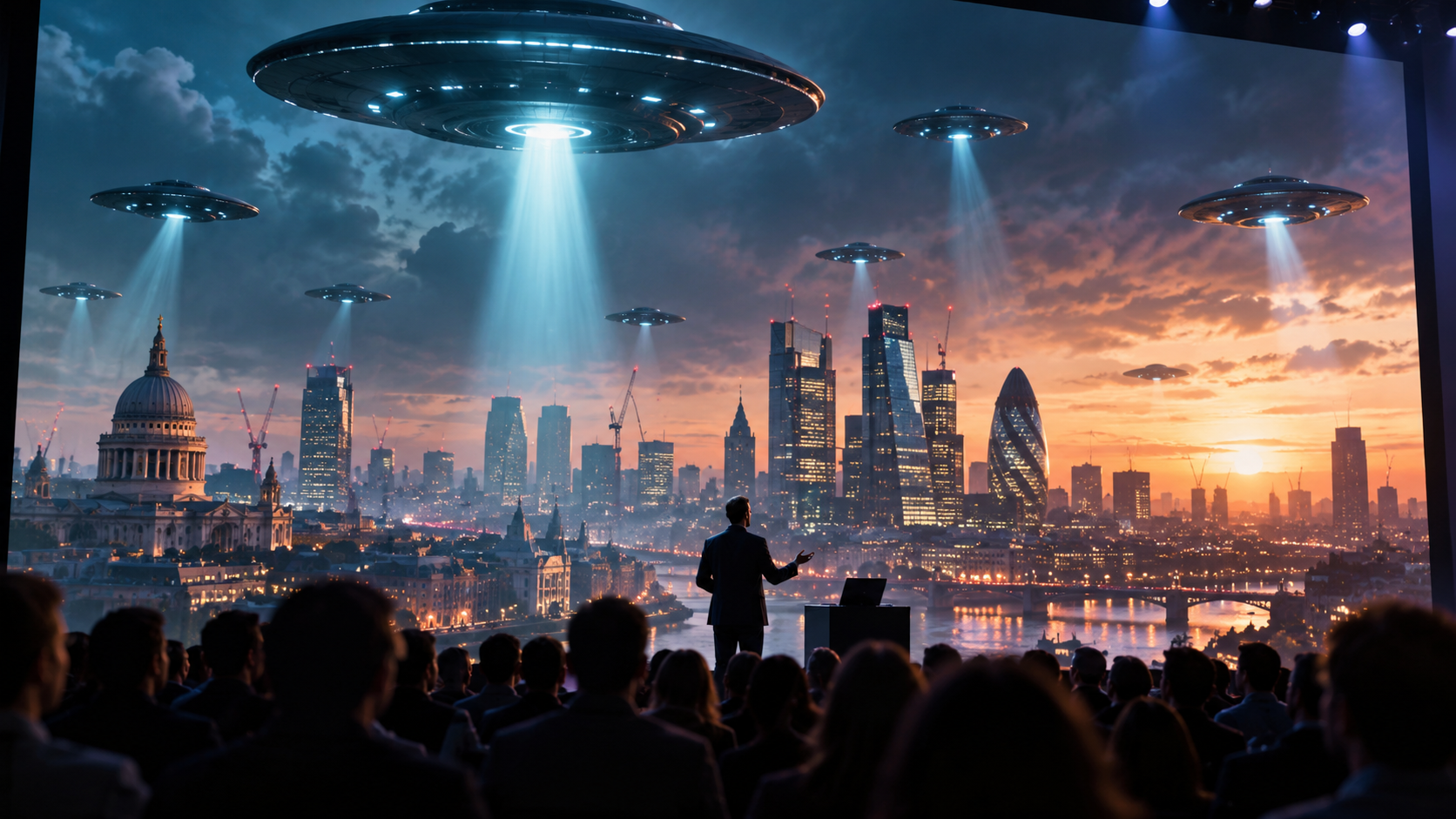

It was my first outing on stage for Microsoft. I was being chaperoned by my hiring manager and he’d decided we were going to do a presentation about how aliens were going to take over the world and Microsoft technologies were going to help us defeat them.
Seriously. I was paid for this.
I’ll be honest, at the time I kept looking around the room wondering where the hidden cameras were and half expecting Dom Joly to jump out and expose the charade.
It seems, although I didn’t realise it at the time, that I’d stumbled into one of the best jobs in the world. I’d been hired as a Creative Technologist at Microsoft. This was 2010: an unbelievable job title, at an unbelievable company, at a remarkable time in the evolution of technology. I’d applied to a job posting in The Guardian, never really expecting to hear back. But I did, and with each phone call and interview I met more and more people who moved me from thinking “this is a job I want” to “this is a company I want to work for” to “these are people I want to work with.”
More than fifteen years later, I can still remember some of those interview rooms, I def still remember the people sitting in them.
Sorry, what was I saying, oh yes, aliens…
The Microsoft UK PR team had asked us (Technical Evangelists) to support an event for the press and some big UK customers. There wasn’t a particular product we were there to launch. The point, as I remember it, was broader than that. Microsoft was changing. There was some genuinely interesting stuff happening and we wanted people to see it.
My boss had decided that rather than stand there and tell everyone how innovative Microsoft was, we’d show them. And we’d do it by weaving as many new and emerging technologies from Microsoft and Microsoft Research as we possibly could into one magnificent story.
And some of this stuff was astonishing.
Photosynth was wizardry. Bing Maps was becoming much more than a map. Microsoft Research doing contextual image recognition. Remember, this was 2010. The iPhone was three years old. A phone understanding what you were looking at, where you were, what was happening around you and then doing something useful with that information wasn’t normal.
This stuff felt like the future.
I was a few months into a job where I was being given access to it and then, apparently, being paid to stand on a stage and talk about it.
So naturally we used it to fight aliens.
I can still remember standing on stage and looking across at my boss at the podium to my right, thinking:
Are we really going to do this?
And we did. We showed how these different pieces of technology could help us discover more about the aliens, work out where they were and understand what they were doing. Looking back sixteen years later, some of it feels slightly spooky, but at the time it felt like the future and it was fun.
The leadership-team report would probably have used the word engaging. It showcased a whole collection of Microsoft technologies inside one deliberately improbable narrative.
At one point I needed to sign into one of the services. I used my Gmail account because that’s what I used at the time. Of everything we’d shown, that was the bit the socials picked up on:
“Haha, the guy from Microsoft uses Gmail.”
Spooner, welcome to Microsoft.
I realised quite quickly that some people in that audience weren’t particularly warm towards Microsoft. Some actively wanted to see us fail. We could have stood there and told them how innovative our technology was, listed features and capabilities, shown architecture diagrams and hoped they’d eventually come around.
Instead, we’d told them about aliens.
And they listened.
Maybe they came for the opportunity to laugh at Microsoft. Maybe they stayed because the story was unexpected enough to be interesting. Either way, for a little while we’d lowered their guard.
We weren’t trying to persuade them to buy anything. We were trying to get them to look at Microsoft differently. And inside this slightly bonkers story we’d shown them ideas around image recognition, mapping, social data, context and location that were only just beginning to become part of everyday technology.
After the presentation, Mark said something along the lines of:
“OK. You’ve got this. Off you go.”
And that was pretty much it. The stabilisers were off.
Over the years that followed I stood on a lot more stages and talked about a lot more technology. Some of it was genuinely complicated. Some audiences wanted to hear from us. Some definitely didn’t. But I’ve kept coming back to something I learnt while standing on a stage talking about an alien invasion.
Humour and the unexpected have a place in serious technical presentations.
Particularly when you’re talking about the future.
In 2010, Photosynth felt like wizardry. Computers recognising photographs, understanding where we were, connecting information to places and working out what was happening around us felt genuinely extraordinary.
Today, most of that is just my phone.
And now we’re doing it all over again with AI. We’re seeing things that feel astonishing, trying to understand where they’re going and wondering which of today’s seemingly ridiculous possibilities will feel completely ordinary in another fifteen years.
That’s where a story can help. A story gives people a way into something they don’t yet understand. Sometimes it gets them to stop thinking “here comes a tech company to sell me something” and start thinking “hang on, this is an interesting story.” And for a few minutes, they forget they’re being sold to.
Sixteen years later, I still remember how extraordinary that technology felt.
But mostly I remember the aliens.
If a feature walkthrough isn’t going to cut it for your next keynote or product launch, let’s find a more interesting way to tell the story.
My name is Andrew Spooner, and I help technology leaders and their teams find and tell better stories. If you’ve got one that needs telling, get in touch.
Remember the aliens?
I’ve shared this story on LinkedIn, where a few people who were there have already joined the conversation — including someone who still remembers it sixteen years later.